The Archies · Report
Beckon the Butler: Chapter One, Bang
A gender-inverted dystopia in the lineage of Atwood's The Handmaid's Tale and Shirley Jackson's "The Lottery," Beckon the Butler unfolds in a no-when world. A town where to want is dangerous, and to be unwanted is fatal.

A gender-inverted dystopia in the lineage of Atwood's The Handmaid's Tale and Shirley Jackson's "The Lottery," Beckon the Butler unfolds in a no-when world, a place that wears the manners of the past and the logic of a future we have not arrived at yet. A town where to want is dangerous, and to be unwanted is fatal.
This is a passion project: for the harm we build no words for.
Miss Pomeroy kept her classroom as one might remember a clothesline: evenly spaced and meticulously ordered, as though the sun worked for the linen and must not mistake the privilege. Even the chalk dust on the blackboard seemed to know where it might settle. The windows stood open a cautious inch, and through that inch the March morning entered meek and civil, light slight and warmth slighter still.
In the Remington township, a birthcard follows each child into the classroom. Its face bears the town's emblem: two crossed keys beneath a narrow sunburst. Below that, the words In God We Trust, oddly remembered from elsewhere. A small frame fixes the card to the front of every desk, one face turned to the room, the other turned in to the wood.
It is Review Week. The boys with finished birthcards are seated in front, their desks arrayed in a row like a pantry's shelf of labeled jars, each one bearing his name and the use the town found in him. Those without take their places beneath the clock at the back, where the hand above seems less concerned with this morning's hour than with the slow, official business of sorting unnamed children.
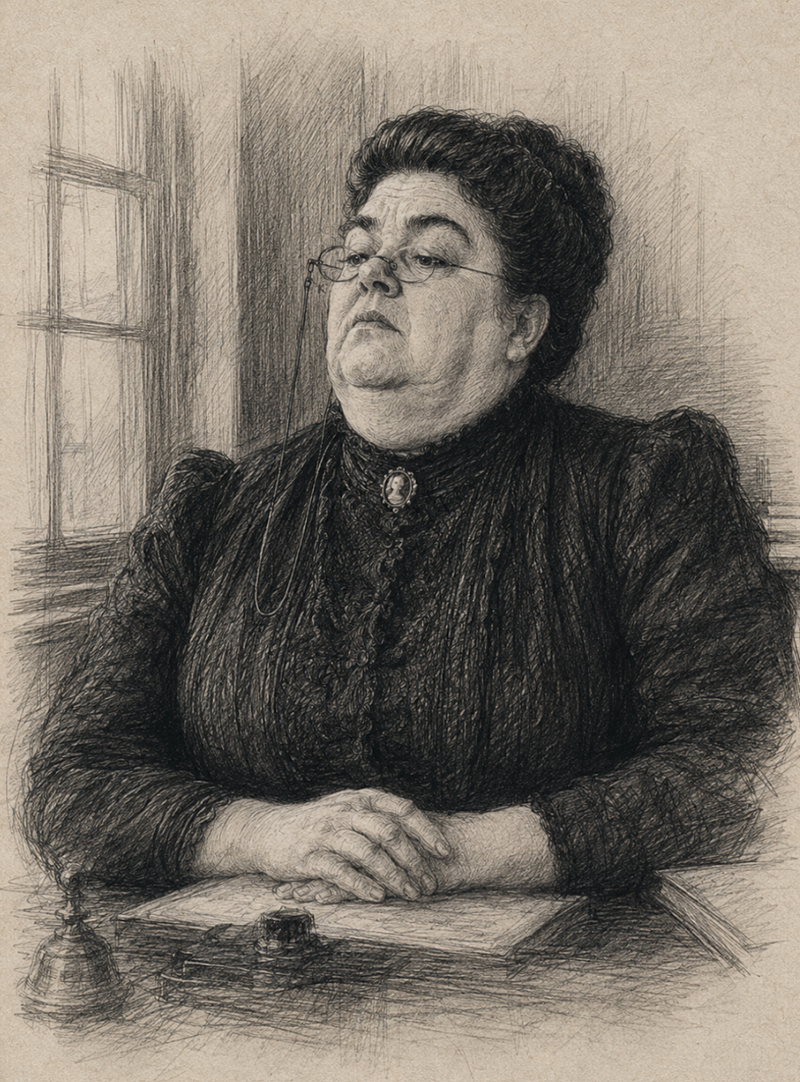
"Class," said Miss Pomeroy in a voice that resembled the clean snap of folded paper. "Review Week is no excuse for restlessness."
In Remington a girl was named once, early, and for good. Her mother spoke the name for the first time to her daughter while the newborn was still warm from washing and small enough to be wholly in her arms. She wrote it in her best hand, centered on the back of the birthcard, with a careful eagerness.
Girls' names went with them, from birth, through school, through market, into office, into age. Agnes Vale remained Agnes Vale. Anna Corin remained Anna Corin. Her name stood for her as a house stands on its lot: known, placed, and not to be moved without disturbance. From the morning she first took her seat, the front of her desk, care of a completed birthcard, announced her.
A boy's card bore a different preparation: on the back there was a single line drawn straight down the middle from top to bottom. It was only a line. It was not an innocent one.
Through the early years his birthcard was kept in a frame in the home, so that any glance upon it returned only the town's emblem. In those years he was spoken of only as a boy of the house. His name was kept between the card and the mother who had given it, shrouded in the quiet like some small private disobedience. It was not uncommon for a boy to grow into the sound of "Elder Boy," and to answer to it in the first disciplines and minor tasks required of the house that held him.
The birthcard followed him to school on his first day and took its place in his desk, graduating from the discipline of one room into the burden of another. Only during Review Week did the schoolmistress draw the birthcard clear, read the mother's hand from the left side, and enter on the right the use for which the town had need. Thus a hidden Nathaniel became Nathaniel Ash-boy, an Ellis became Ellis Gate-boy, a Martin Step-boy.
The higher names were not given lightly. Some boys were marked early for the low work: Ash-boy, Step-boy, Pump-boy. Better ones waited for steadier natures and quieter feet: Pantry-boy, Hall-boy, Glee-boy, Gate-boy. Above them all stood Butler, the black-coat office every boy in Remington listened toward. In the better houses they did not send for him. A bell was touched, and the household understood.
In the classroom, the girls sat neat as hymnals, and from the pegs behind them hung the padded gray muffs Remington favored as one of its gentler contrivances. Lined in felt and packed with wool, they admitted only what was proper. Miss Pomeroy's voice remained, along with the small order of the room. Anything beyond was reduced before it reached them.
Among the girls the town kept its own distinctions. Nearest the front sat those whose company spared grown women the private labor of comparison. They were plain in the way Remington liked plainness best: full in cheek and figure, not weak, not vain, not given to troubling pew or parlor by presence alone. One could foresee in them the keys at the belt, the lists in hand, the voice grown firm from years of being heard.
There were others in whom a gentler value had begun to show. Remington called them lantern girls in the tone with which a town pets what it means to govern. They were the thin bright ones, the girls in whom notice had begun, quietly, to settle. Not because anything in them burned more intensely than in the others, but because the town had learned the outline of prettiness and would not have it arrive unclaimed.
Like many things in Remington, the day never seemed fully admitted. The town had the look of a place some old London fog had settled over and forgotten to lift. In such a place, any brightness was soon made useful.
So each lantern girl was made to keep her own: a small brass frame with a clear glass and narrow chimney, the town's seal set plainly upon it. When she was seated, it was hung upon a slight upright fixed to the chair, so that the page, the hand, and ultimately the whole of Miss Pomeroy's room were spared the inconvenience of dimness.
Lantern girls were not seated near one another for the same reason candles were not stored too close in summer, nor silver left in a heap, nor ribbon kept loose in a drawer. The town did not trust pretty things to one another's company. It had observed, over time, that brightness, when given its own reflection, begins to answer to itself, and in doing so forgets the hand that set it out.
A lantern girl's wardrobe was cut without a waist, falling straight from shoulder to hem, so that no line in her was taken up or held. Where others went bare-headed within the schoolroom, she was given a bonnet, tied neat beneath the chin, and arranged with a care that blunted what might otherwise have been too plainly understood. Her pinafore was drawn higher, the bib set close beneath the throat. The sleeves were made longer than the season called for, the cuffs carried just past the wrist, so that the hand appeared only in part and never entirely of itself.
Anna Corin was a lantern girl.
If beauty was to be suffered openly, the town preferred it on a boy: in the narrow make of him, the clean line from shoulder to waist, the face that held its planes without excess. He was the sort the eye found easy to place, slight in frame, unthreatening, and lean in a manner that suggested each ounce of him might be converted cleanly into use for the town. There was a quiet pleasure taken in such proportions, though it was never spoken of as pleasure, only as correctness.
What the town disliked was force: any early thickening through neck, shoulder, or chest that suggested a body inclined to its own use. Such growth came on out of season, as though the figure had gathered itself toward a purpose no one had called for. Remington liked boys slight, exact, and already practiced in taking up as little room as a growing body could be made to take.
School in Remington did not keep one lesson for all. The girls were taught copywork, minutes, notices, invitations, condolences, and the quiet forms by which private trouble becomes public order. They learned accounts, the framing of questions, and how to set confusion straight upon paper, so that a girl would learn early what sort of burden had once been permitted to call itself ordinary. These were the offices she would in time choose among, and the schoolroom was where she came to know them.
A boy's best instruction was in those motions by which a household, and after it a town, is spared the spectacle of asking twice. He would learn to lower a sash without waking the glass to its own complaint, to carry hot water level, to set down coal without a report from the scuttle, to cross a floor with his sleeves, his knees, and his shadow all in obedience together, and to wait upright till called, as though waiting were itself a form of readiness the body might be trained to keep.
All over Remington the bells did the finer speaking. A handbell in a front room called Hall-boy or Butler; a kitchen pull set Ash-boys moving below stairs. The town liked bells because they left command well mannered. The bell spoke, the boy answered, and the interval between the two was counted among the town's more modest virtues.
This gave the boy his true schooling: learning the correct reply. He was to be near without seeming to hover, useful without seeming to possess a will in it, and so practiced in answer that the town might pass its needs through him without once having to raise its voice.
At intervals Miss Pomeroy read from the older ledgers kept in the cabinet, their pages holding the town's quieter reckonings: contracts badly held, inventories run short, petitions entered by wives whose cupboards and children had borne the cost of appetite, temper, and pride. The entries were read as written, dated, and shut again into the book. No sermon followed. None was called for.
During morning recitals Miss Pomeroy gave the signal, and the room rose together. Each hand was laid flat above the heart, each head inclined in its proper degree, and the words were given once, in a single voice:
"Through Our Process, what is set in place is made clear. Through Our Process, what cannot be made clear is removed in pursuit of Truth Complete."
And still, for all the bells and copywork, the schoolroom kept circling the same errand. Under the clock, three desks still showed only the emblem outward, the birthcards within them turned in such a way as to condemn the name behind. The three boys they belonged to were of the age when Remington stopped letting time make excuses for them. But a boy in Remington did not lie awake imagining the black coat. He lay awake listening for any name, any office, any place on the Board's page that would consent to receive him.
The first of the three had grown too fast for his own government, all reach and startlement, with hands that seemed forever to arrive a moment before the rest of him. The second had come broad too soon, and fright made a noise of him: in his breath, in his tread, in the way iron or wood answered back when he laid hold of it.
The third was harder to account for. There was early timber in him already: the neck settling thicker at the base, the forearms beginning to fill, the chest carrying the first grave promise of a man's weight rather than a servant's finish. Years would only make more of him. Worse, he gave the town no useful failure to put beside it. He moved carefully, spoke little, and had a way of setting things down so that the thing itself seemed to find its own place. The town could have forgiven clumsiness sooner than it could forgive the wrong shape made graceful.
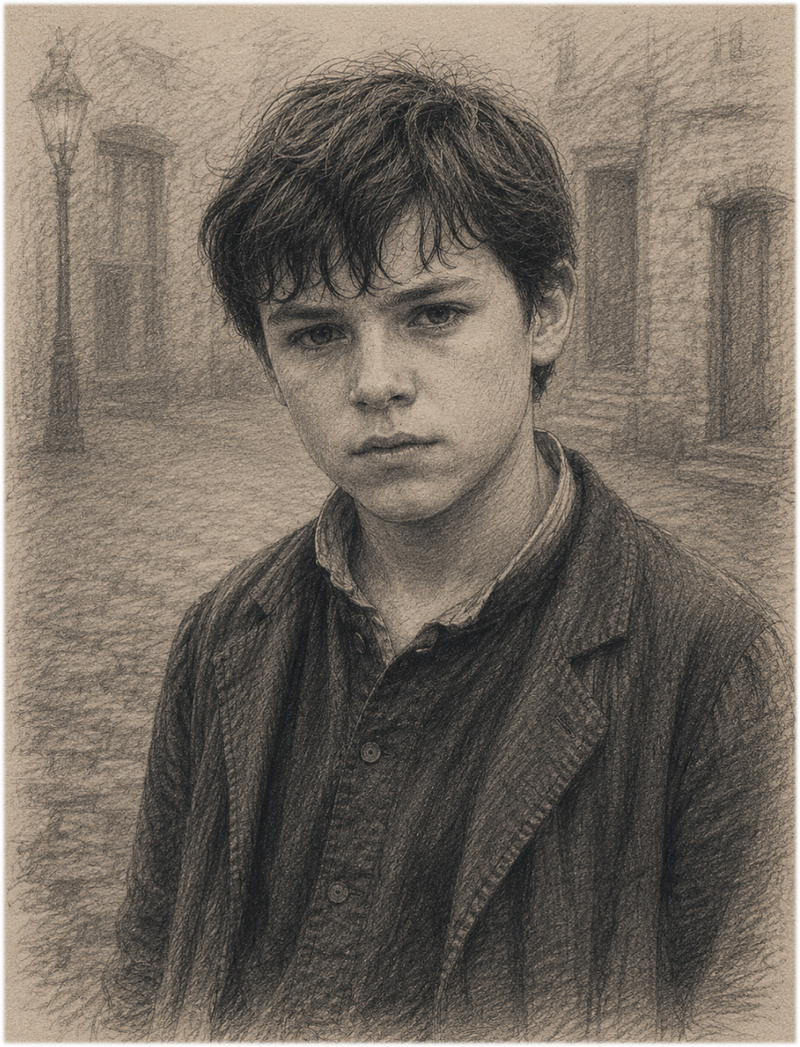
Before Review Week made a question of him, Anna Corin had already begun to know the third boy by answer. It had begun the summer before, in the close gray heat that passed for August in Remington, and had carried her, by quiet stages, through the whole turning of the year. In Remington even liking was obliged to travel under some useful sign, and so theirs began in errands.
During that August, at the pump behind Saint Odilia's, she set the bucket beneath the spout, gave the iron one decent trial, and said, "Elder Boy." Wherever he stood, he came at once: "Yes, Anna Corin." He would free the stiffness from the handle and bring the water up, then step aside before the pail had half-filled, leaving the task to appear hers. If the flow faltered, he kept his eyes on the iron, as though the pump were the thing that wanted watching and not her.
The pump stood in the churchyard's lee, where Saint Odilia's gray stone broke the wind and the cobbles ran green between the stones. A sound pump, by any fair account. But a girl may find a handle stiff if she has reason to, and Anna had begun to find reasons. It happened so the first time, on a Tuesday she remembered without meaning to. It happened so the second, a week later, when the heat had thickened and the handle was warm enough to mark the palm. By the third Tuesday she had begun, in some quiet pocket of her morning, to wish a little for the trouble to return, and to mistrust the wish even as she made it. By the fourth and the fifth she had stopped counting them as separate occurrences, and had begun to count instead the days between.
Autumn brought its proper errands and a different room for them. The stationer's was a narrow shop, deeper than it was wide, the counter running the length of one wall to a window of small panes that let the afternoon in and laid it flat across the brown paper. The window, when the leaves turned, showed paper tied in tight parcels against the damp, and the string the proprietor used grew hard on the fingers as the weather sharpened.
One October afternoon, when Anna had paid and turned away with her bundle, a small packet of wafers remained beside the scales. The stationer had not noticed. Anna had not noticed. Elder Boy had. Before the bell above the door could finish announcing her departure, he took up the packet, followed her to the threshold, and slipped it beneath the crossed string of her parcel, so neatly that the order seemed to have corrected itself. By the time she turned, there was only the back of him to thank, already withdrawing, already nearly gone.
After that, the stationer's became, by no plan she would have admitted to, a place where she was often found at the hour he passed through it. She kept to the front near the door; he worked the far end by the storeroom curtain, the length of the counter always between them. He did not always speak. Sometimes she marked only the dark line of his shoulder at the far end and knew, by the quality of her own breathing, that he had seen her too.
By December, the accidents had begun to travel with her.
On a wet morning, when the almoner's gate had swollen in its frame, she stood with her hand upon the latch a moment longer than the latch required, long enough for a boy accustomed to answering her to notice. The gate opened onto the cobbled lane behind the council hall, where the low gray row of the town's offices began and where the third boy often passed after work. He came without haste, without noise, and the wood yielded beneath his hand. Both had answered her, and neither had been asked.
He did not look at her afterward. By then he had learned the discipline of not looking, and she had learned to know him by the care with which he kept his eyes away.
And, at the turn of the year she had begun, without confessing it even to herself, to choose the corners where such small resistances gathered: the slower pump on a frozen morning, the sticking gate after rain, the iced step before the stationer's door. She still called him Elder Boy, because the town had not yet seen fit to name him; yet she said it more gently than others did, as though keeping warm a place for what was meant to come after.
The bonnet the town required of her did its work so faithfully that even after half a year of these accidents he knew her face only by pieces: the turn of a cheek when she bent over the pump in August, the quick gravity of her mouth at the stationer's counter in autumn, the brief, startled fullness of one eye in December when the brim failed for a moment in its office.
On shorter winter days, when the weather lay thick enough to make the road uncertain, it was no irregularity for a boy to walk a little way beside a lantern girl whose path ran near his own. He kept to the outer edge of the road, where the frozen ground crunched and held, and if the wind came up he would lift a hand, not touching the lantern, but set near enough that its flame did not falter.
In that narrow moving circle, he would see a little more: the pale edge of her cheek, the slight shaping of her lips, that same eye, caught and held for an instant, deeper and steadier than he had first supposed. But never the whole of her.
"You do not look to me like Ash-boy," she said once, on one such walk in February.
He looked at her with the small surprise he always seemed to reserve for anything easy.
"No?"
"No. Ash would spoil you."
"Spoil me?"
"It would blacken you past recovery."
"That is grave news."
"And furnace-boy would never do."
"Why not furnace-boy?"
"You are too careful with a flame."
He looked at her then with quiet amusement. "Then what remains to me, Anna Corin?"
She considered with more solemnity than the game deserved. "Gate-boy, perhaps. Stable-boy, if the horses were well disposed. Hall-boy, if you learned to look less as though you had been entrusted with some private catastrophe. Butler, if Remington were in one of its generous moods."
"And is it?"
"It has never struck me so."
"Then I must hope for Gate-boy."
"You would not hope for Gate-boy," she said, and had the misfortune to mean it.
At the pump behind Saint Odilia's, on a damp March afternoon nearly a year since he had first answered her there, the iron handle answered back more sharply than either expected. He caught it before it struck, but the jolt passed through the iron into the bucket, and from the bucket into her wrists. The ribbon of her bonnet, already weakened by the weather, gave way. Her bonnet slipped free and fell.
He caught that too.
For a breath he only stood there with it in his hand, looking at her.
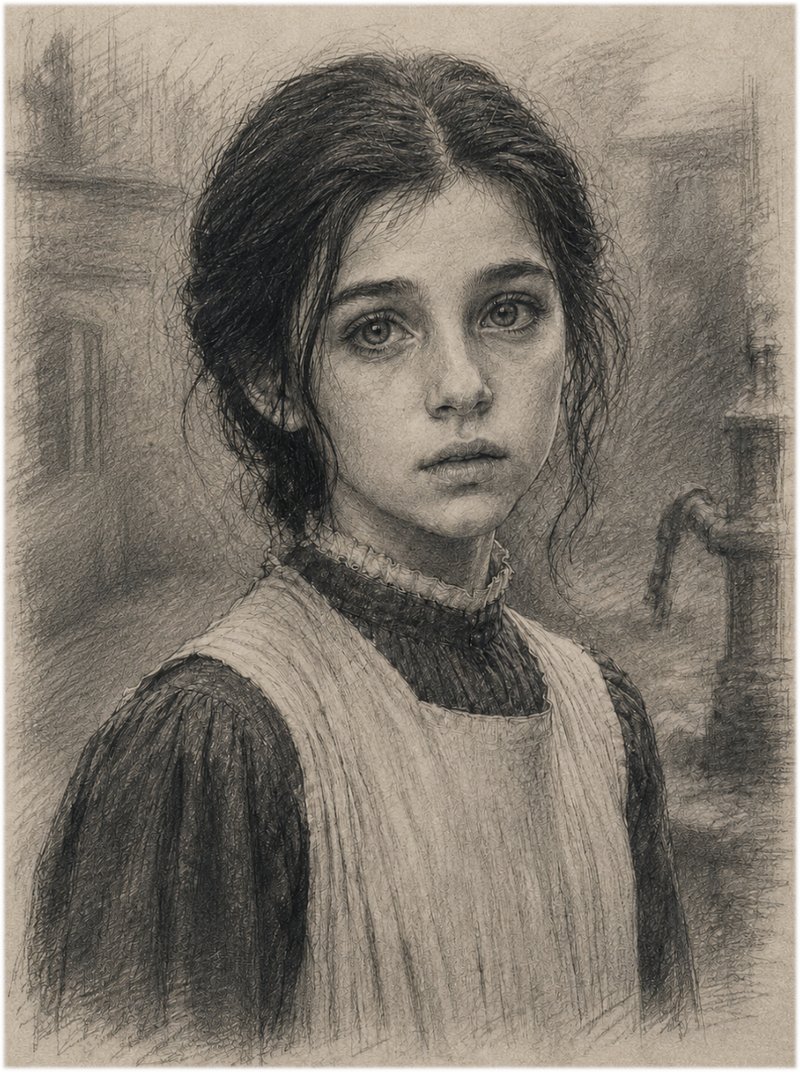
The town had contrived much cloth and caution against that very moment, and for a breath all of it failed. Her hair, pressed flat where the bonnet had held it, was loosening at the temples. The brow was clear; her eyes, seen whole, were larger than he had understood from glimpses alone, grave at first and then startled by his seeing them; the mouth finer than any prudence had prepared him for. He could not afterward consent to remember her in fragments.
She took the bonnet from him too quickly, and then could not seem to manage the ribbons. Her fingers were cold, and the ends had twisted.
"You are making poor work of it," he said, because embarrassment required some employment.
"And you are none at all in the bonnet line," she answered, though her voice had gone thin with it.
"No," he said, "but I may hold the left if that advances matters."
She hesitated only a moment, then gave him one ribbon. He held it with the care of a child entrusted with church silver, eyes lowered now, while she drew the other beneath her chin. Once the knot slipped. Once his knuckles brushed, by no design, the small hinge of her jaw, and both of them started as if the pump itself had spoken. At last the bow was made. She set the bonnet right. The world, having been briefly altered, was restored to its proper obstruction.
"You may yet make Butler," she said, still not looking quite at him.
"Because I can hold a ribbon?"
"Because you did not ruin anything."
"That is very near praise."
"It is exactly praise."
"And if I make Butler," he said, "what then?"
She did not answer at once. For a moment she kept her eyes before her, and her thought, having run ahead in its pleasure, was obliged to return by the road the world permitted. Then, with a small correction in her voice:
"You cannot be Butler," she said.
He glanced up. "Why not?"
"Because Butler ought never to be seen fastening a lantern girl's bonnet."
"I did no such thing. I held one end."
"That is already too near the business."
"Then Gate-boy again."
"Perhaps."
They went a little farther in silence.
Then he said, very quietly, "Do you think it will sound like me?"
Anna knew at once what he meant.
"Your mother would not have chosen poorly," she said. It was more faith than knowledge, but she gave it to him whole.
He kept his eyes on the road. "If I pass."
There was no complaint in the words, only the plain wound of them. She understood then, with a force that shamed every lighter fancy she had yet permitted herself, that it was not the proper office he feared losing, but the chance of any office at all.
"And if they make you Ash-boy?" she asked, trying after lightness and failing a little.
"Then I shall blacken."
"Yard-boy?"
"Then I shall be muddy."
"Gate-boy?"
"Then I shall open and shut."
"Hall-boy?"
"Then my catastrophe shall at least be a clean one."
She kept her voice steady. "And Butler?"
At that, something warmer entered his face. "That sounds like your wish, not mine."
"It sounds like something you might do well."
"And what is my good to you, Anna Corin?" he asked, lightly, though not altogether in jest.
She lowered her eyes to the parcel in her hands. "I should like," she said after a moment, "to hear you called for something."
He said nothing then, and she was grateful, because any answer would have been too much.
It was April before the matter turned tender. The handle had been stubborn all morning. Anna set her hands to it, failed once with dignity, and said, "Elder Boy," in the tone she kept for him alone, half summons, half trust. He came at once. "Yes, Anna Corin." He set his hand above hers on the iron, and together they brought it down until the water rose. The first cold spill leapt over the rim and darkened his cuff. He laughed then, only a little, but enough to startle her with the boy still living beneath the careful readiness. Before shyness could come back and tidy her courage away, she reached up and kissed him quickly on the cheek, just where the laughter had been.
The handle lifted slowly under its own return. Water went on sounding into the pail. He touched the place once, not as if to question it, but to keep it.
"If I pass," he said, still not looking full at her, "you shall be the first to use it."
Anna lowered her eyes, because in Remington even happiness was expected to mind its posture. "You must," she said.
After that, whenever she called him Elder Boy and heard him answer, she felt beneath the town's borrowed name the pressure of another, hidden and waiting.
Miss Pomeroy moved between the rows with a ruler tucked beneath one arm like a baton. She was one of those women whom a town trusts at once. Her hair was pinned so firmly it seemed to have forgotten the habit of looseness. Her cheek was full, her jaw exact. She had chosen the schoolroom for herself when she was younger than the children now were, and had never had cause to wonder whether the choice had been a good one.
She paused beside Anna Corin, whose pinafore had slipped the width of a thumb.
"There," she said, tugging it higher. Not unkindly.
She laid the ruler beside the brown review book and looked toward the clock. The named boys in front lowered their eyes to their copybooks. Review belonged to the back row.
No one in the room moved.
"Back row," she said. "First desk. Bring me the wash basin from the stand and set it here."
The long boy rose, took up the basin in both hands, and brought it down the aisle. The water trembled once against the lip. It did not spill, but it had noticed being watched.
"Set it down."
He obeyed.
A mark. He swallowed once. Pantry would have him; the town had a pantry that wanted keeping, and what he had done was sufficient, if not handsome.
"Second desk. Move the coal scuttle to the stove."
The broad boy bent and took it up cleanly enough, but the handle struck the iron side with one small betraying note, and when he crossed the room the floorboards answered too loudly to his heels. At the stove he set the scuttle down with a dull little clang.
Miss Pomeroy let the pause after that lie where it fell. In a room so trained, even a small silence had a way of widening.
A mark.
Yard would have him; yards forgave a heavy foot, and a noise made out of doors was no noise at all.
"Third desk," she said at last.
Anna Corin felt her hands go still in her lap.
"Take the readers."
Elder Boy gathered the books against his chest and carried them down the inner aisle without noise, without tilt, and without so much as glancing at the girls whose desks he passed. One by one he laid the readers before them. At Anna Corin's desk he set hers square to the edge with that same quiet care by which things in his hands seemed always to arrive where they had meant to be all along.
At the end of the row Anna forgot herself and lifted her eyes.
It was only a moment. Her head had turned before she knew it had turned. The pale seam of her collar caught the light.
Miss Pomeroy had seen.
"Anna Corin."
The girl bent lower over her desk.
Miss Pomeroy took back the last reader from the boy's hands and stood for a moment. Her gaze passed over him in the brief, practiced way of women who have long since learned to take a measure at once.
The task had not failed him. That was not the difficulty.
The books lay square. The aisle had received no sound from him. No sleeve had brushed a desk, no board had complained beneath his foot. He had done exactly what a boy was taught to do, and had done it with a troubling ease.
He could be placed. She knew it as plainly as she knew her own ruler. Gate would suit him; Hall would not refuse him; in another year, in a generous mood, even the black coat was not impossible. He had the hands for it and the quiet for it.
The pantry had its boy now. The yard had its boy. The gate had a boy already, and a second in waiting. A town the size of Remington kept a short ledger, and the ledger was full.
A surplus boy was a question. A surplus boy with the wrong body was a question with an edge to it. And a surplus boy with the wrong body, at whom a lantern girl had just lifted her eyes.
That was no longer a question. That was the answer to one.
"Return to your desk," she said.
He did.
The ruler tapped once against her palm. Outside, faint through the inch of window, came the sound of a cart rolling over bad stones in the square.
Miss Pomeroy crossed to the back row and drew the three birthcards from the fronts of the desks, each one slipping free with the small dry sound of a card leaving its frame. She carried them back to her desk and laid them in a row beside the review book. The ruler went down. The ink was uncorked.
She held the first birthcard close to the page, the way a clerk holds a receipt against an entry, and ran the words off under her breath as the pen confirmed them.
"Samuel. Back row, first. Basin, sufficient. Pantry."
The pen moved to the right of the dividing line and entered the office there in her smallest hand. She set the birthcard aside.
"Henry. Back row, second. Scuttle, sufficient. Yard."
Again the pen moved. Again the birthcard was set aside.
The third she turned, and held the pen back from it.
Her eyes fell to the left of the dividing line, while her pen hesitated over the right, where his office should have been entered, and where, as of that moment, it had yet to be.
But it did not move.
Jasper.
What a hopeful little name, she thought.
And she left it so.
She set the birthcard aside.
Miss Pomeroy recapped the ink, squared the three birthcards with the side of her hand, and lifted them together.
She stood from her desk and spoke in the voice the schoolroom knew, level and public, made to reach the back of the room without ever seeming to rise.
She went down the aisle to the row under the clock.
At the first desk she returned the birthcard to its place, name and office outward now, and let it settle before she spoke.
"Samuel Pantry-boy."
For a breath it was the first word that struck him harder than the second. No one in the school had ever said it where he could hear.
At the second desk she returned the next birthcard the same way. A name took the room. Again the pause. The same voice again.
"Henry Yard-boy."
The hidden name reached him first, and the work appointed to it after. He stood a little straighter, as though the town had at last spoken aloud what his body had been begging to say all winter.
Without breaking stride Miss Pomeroy crossed to the cupboard beneath the wall maps and turned the small key at her waist. From within she drew the blankbox every review room kept under Board rule: a square case of blackened wood, plain as an omission, clasped and unmarked. The girls knew its shape better than its purpose. The boys, by the age of review, knew the reverse.
She brought it back to the third desk. She did not return the birthcard. She set it instead in his hand, withheld from the room, and from Remington. The slot at the front of his desk, which had borne the emblem for as long as he had used the desk, now bore nothing. Wood and a narrow empty frame, with no card in it to be read. The desk had ceased to announce anything at all.
There are silences that belong to snow, and silences that belong to church, and silences that belong to places where grown people have decided something about a child and mean to call it proper. This was the third kind.
"Girls," she said, "the weekly exercises are not behindhand, and want finishing before the bell. Keep your eyes upon your books. Muffs now."
At once the girls reached behind them for the padded gray cups and drew them over their ears with the practiced calm of long use. The room remained. The world withdrew.
"Boys," said Miss Pomeroy, "eyes front."
Then, to the third desk only:
"Take your birthcard and the blankbox to the Annex."
There was one grace attached to the Annex and only one. A boy sent there blank might turn the birthcard for himself before the last report. He would see the first name his mother had written in hope, the question he had carried all his life and never been allowed to open, answered to him once, in the only privacy Remington would give.
He rose. He carried the birthcard in one hand and the blankbox in the other. He passed between the desks and did not look right or left. Whatever else Remington taught its boys, it taught them how to go where they were sent without asking a schoolroom to pity them.
This was the business of Remington. Anna Corin did not move.
She placed the padded muffs over her ears, securing herself to the small order of the room, and against what, in some unpermitted part of her, had already taken the name of horror.
There was, for a moment, something in her inclined to rise against it, an impulse without sanction and not to be indulged. But Miss Pomeroy's line admitted no such irregularity. Her hand continued. The letters formed in their proper order. The exercise went on.
She did not look. It was not required that she should. Yet she was sensible of his passing, as one is of a change in the air: something near, the faintest dry shift at the edge of her desk, and then no longer so.
Through Our Process, what is set in place is made clear.
It came not as a thought, but as a reflex that corrects thought.
Through Our Process, what cannot be made clear is removed in pursuit of Truth Complete.
She said it again, silently, and a third time, as the town had taught her to do when the line of thought needed straightening.
At the door he paused only long enough to open it without sound. For an instant the classroom took in the March air outside: cold iron, thawed mud, the damp smell of geranium boxes from yesterday's rain. Across the yard, below the school and beyond the tax office, stood the low brick building with its frosted windows, its tidy flower boxes, and its door painted the same grave green as the council hall.
The Annex.
The door closed.
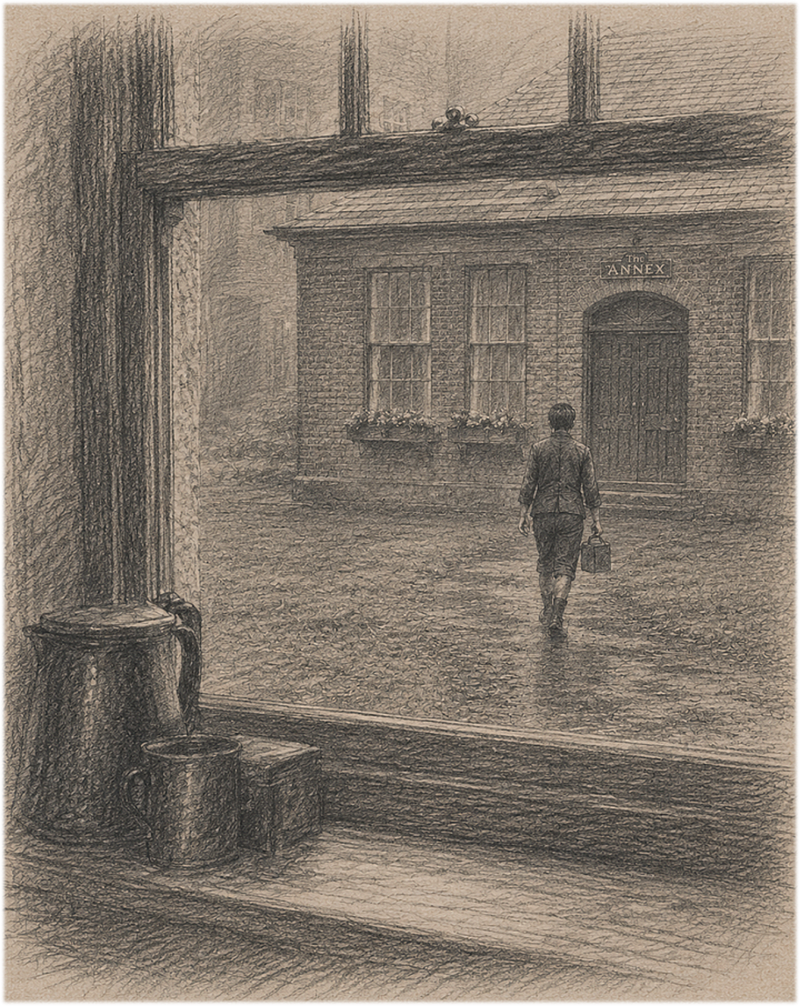
No one was permitted to turn toward the window, though the glass, had they looked, would have carried his small dark figure across the yard, the blankbox in hand, the other empty, toward the green door.
No one was permitted to count the breaths between the shutting of the schoolhouse door and what answered from beyond the wall.
The room went on keeping itself.
Around her, every hand obeyed, because every hand had been taught to obey. The pencils went on the paper because the pencils had been told to go on the paper. The bell would ring presently and the morning would be entered as the morning had been entered every morning before it. Anna's hand continued among the others, because the others continued, and because the small order of the room admitted no exception.
The copy exercise received another word, and then another. Only when she reached to steady the reader did her fingers meet the small, stiff interruption beneath it.
The birthcard.
He had left it there in passing, with the same quiet exactness by which he had once slipped the forgotten wafers beneath the string of her parcel at the stationer's.
For a moment she did not understand.
Then she did.
"If I pass," he had said, "you shall be the first to use it."
He had not passed.
But he kept his promise.
And spent his one grace on her.
She drew the card beneath the shelter of the desk and opened it.
Jasper.
The name lay there in the mother's hand.
He had gone to the green door without it.
Her breath went once, and did not return in the same manner.
She closed the card. Her hand went back to the page because Miss Pomeroy's line admitted no pause. The copy exercise advanced under her pencil, one careful letter after another, until somewhere short of the end it could not advance further. The pencil stopped where it stopped. She did not lift it. She did not push it on.
The muffs held. No sound came of it. Yet within that padded hush, where the room could not follow, the name turned once and became address.
Oh, my sweet Jasper.
Bang.
If this story reaches somewhere that hurts, you don't have to carry it alone. In the U.S., you can call or text 988 to reach the Suicide & Crisis Lifeline, available any time.
New chapters of Beckon the Butler arrive first for subscribers at signalbylandy.substack.com, free.
Filed under: The Archies